Ask any seasoned caterer where they lose the most money, and they won’t tell you it’s marketing or venue rentals. They will tell you it’s the kitchen handover.
Picture this: You have a signature Butter Chicken or Paneer Pasanda recipe that your head chef has perfected for 50 guests. It’s consistent, the portions are exact, and your profit margins are locked in.
But this weekend, you have three concurrent bookings:
- A corporate lunch for 120 guests.
- A birthday party for 45 guests.
- A premium wedding reception for 650 guests.
How does your team calculate exactly how many kilograms of tomatoes, dairy, spices, and meat to procure from your vendors?
If you are like most catering businesses, someone opens a spreadsheet, grabs a calculator, or scribbles math on the back of a cardboard box. They multiply the base recipe ingredients by the guest count, round up “just to be safe,” and send a chaotic text message to the vegetable supplier.
This manual guesswork is a silent business killer. Here is why spreadsheet-based recipe scaling is bleeding your catering profits, and how a systematic database approach can save your margins.
The Hidden Costs of Calculator Catering
When you scale kitchen production formulas manually, human error inevitably slips in. This creates two massive operational drains:
1. The Over-Ordering Trap (The Profit Drain)
Because no caterer ever wants to run out of food at a live event, manual scaling always defaults to over-purchasing. Buying an extra 10 kg of dairy or 20 kg of premium vegetables “just in case” completely destroys your per-plate profit margin. By the end of a busy wedding season, untracked ingredient wastage can add up to thousands of dollars in lost revenue.
2. Last-Minute Panic Buying (The Logistics Nightmare)
The opposite error is just as dangerous. Underestimating a core spice or an essential prep item means your kitchen team discovers a shortage mid-production. Suddenly, a utility worker is dispatched on a panic run to a local retail market, buying ingredients at peak retail prices rather than your negotiated wholesale vendor rates.
3. Course Section Confusion
When tracking multi-event menus across spreadsheets, it’s incredibly easy to miscalculate how a raw material is distributed. If onions are needed for both the appetizers and the main course, a manual calculation often undercounts the total bulk volume required, leading to chaos on the assembly line.
The Solution: The Recipe-Driven Procurement Engine
To scale a catering business successfully, your menu planning must talk directly to your inventory procurement. You need a centralized system where your kitchen formulas are digitized once and automatically compute required weights based on live event variables.
When you shift from isolated spreadsheets to an integrated cloud platform, the operational workflow transforms:
- Absolute Mathematical Precision: The system takes your base formula per plate and calculates the exact aggregate raw material needs for the entire order instantly, removing human error entirely.
- Drill-Down Visibility: You can analyze your material consumption report by individual items to see exactly which dishes are driving your highest ingredient costs.
- Seamless Supplier Handovers: Instead of messy WhatsApp threads, the system instantly organizes your calculated raw materials by default supplier, creating structured, professional lists ready for ordering.
How Neviscater Protects Your Kitchen Margins
This exact level of operational control is why we built Neviscater. The platform replaces chaotic manual calculations with an end-to-end digital lifecycle.
Inside Neviscater’s Recipe Management Module, you define your raw material formulas just once per dish. When you build an active order and add items to an event’s menu, the system’s under-the-hood engine takes over.
If a client calls to change their guest count from 200 to 450 mid-week, you simply update the number in your dashboard. Neviscater instantly re-runs the calculations across your entire menu, updates your Material Consumption Report, and shows you the exact adjusted weight of raw materials needed.
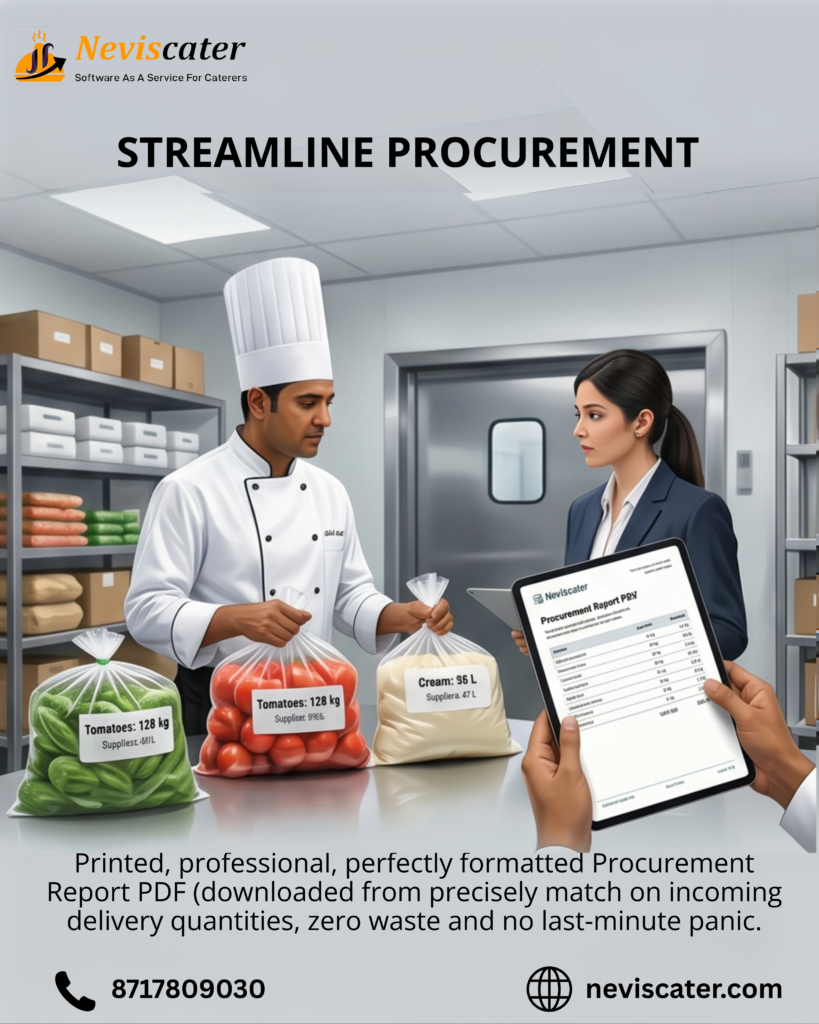
From there, you can use the Procure Action to instantly review your purchasing quantities, assign specific vendors, and even download a clean Procurement Report PDF or email the requirements directly to your suppliers.
Protect Every Plate
Running a catering business is a game of logistics and margins. Don’t let manual spreadsheet errors dictate your profitability. By digitizing your master item recipes and automating your material consumption, you gain absolute control over your kitchen inventory, minimize food waste, and ensure every single event is a profitable one.
Recent Posts
-
 The Math of Multi-Event Catering: Why Scaling Recipes on a Spreadsheet Is Eating Your Profits
 -
 Simplify Catering Management: How Neviscater Enhances Menu Creation and Cost Estimation
 -
 Recipe Adaptations for Large-Scale Catering Events
 -
 Secure Data Handling: Cloud-Based Storage and Local Backup Options with Neviscater
 -
 manage inflation by adjusting rates for menu items